
Prefer to listen instead? Check out the audio version of this article
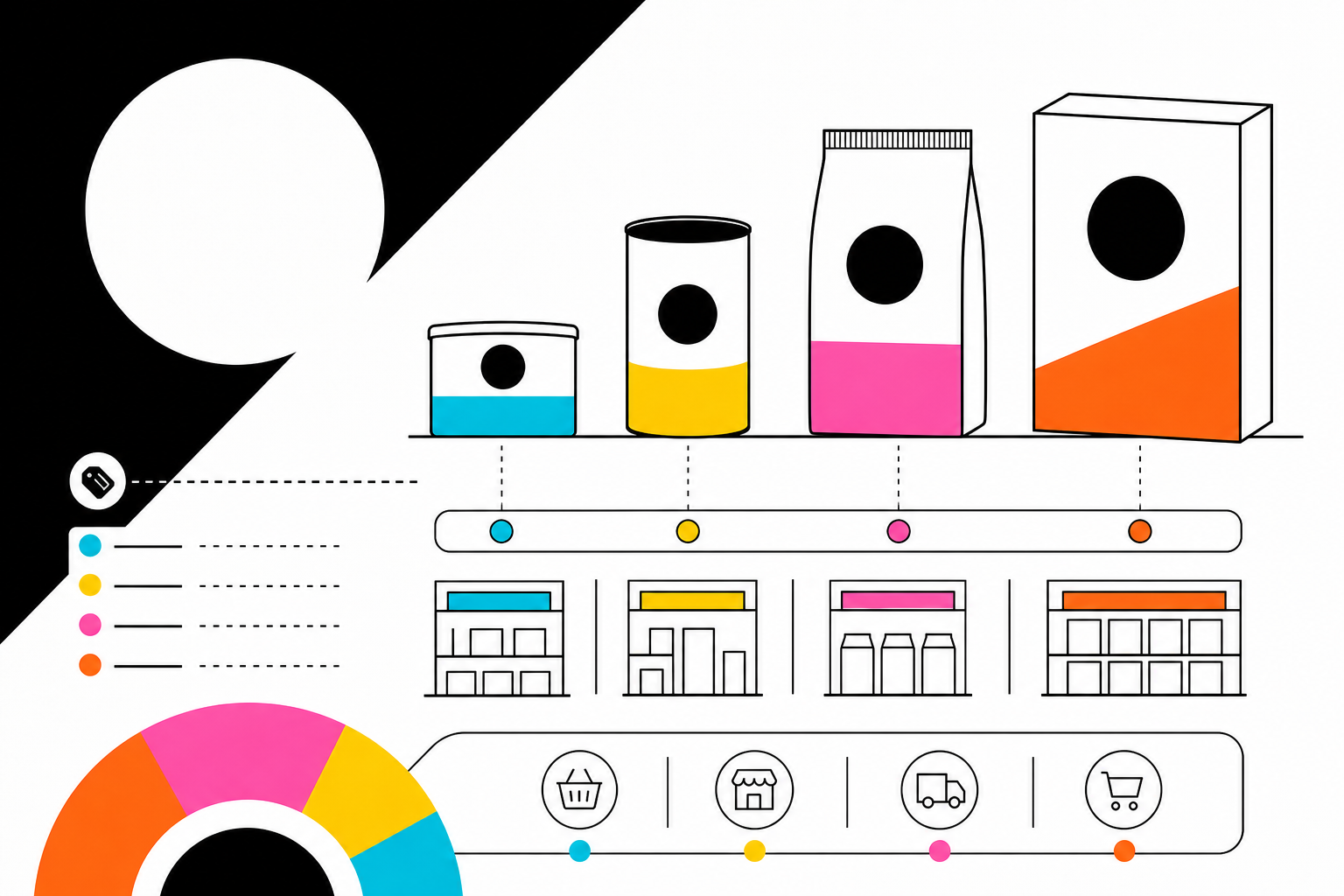
Price Pack Architecture, or PPA, is the deliberate design of a CPG brand’s pack sizes, formats, price points, and channel roles so each offer serves a clear consumer and commercial purpose.
PPA is broader than deciding how a product should look on shelf. It is also different from setting a single price or running a promotion. PPA defines the relationship among the physical offer, the price shoppers see, the role the pack plays, and the channel in which it is sold.
A well-designed architecture can help a brand make more coherent decisions about pricing, promotions, product mix, assortment, distribution, retailer economics, and demand planning. L.E.K. describes consumer price-pack architecture as the optimization of price points, packaging, configurations, and product attributes across a portfolio. EY similarly frames pack-price architecture around the structure of a product range, including pack sizes and price dimensions.
For CPG brands, the central question is not simply, “What should this product cost?” It is:
Which combination of pack, price, format, channel, and consumer role creates the strongest overall value for the brand, its retail partners, and shoppers?
Consumers rarely evaluate price in isolation. They also consider how much product they receive, the price per ounce or serving, the relationship between pack sizes, the convenience of the format, and whether the offer fits the occasion.
Retailers and manufacturers evaluate additional factors, including margin, turns, shelf productivity, trade investment, logistics, inventory, and demand. A pack that looks attractive from a consumer perspective may create weak retailer economics or excessive operational complexity. A pack that improves manufacturer margin may not meet a shopper’s entry-price expectations.
PPA helps bring these considerations into the same decision.
A portfolio may contain several products or packs that appear different internally but serve nearly the same consumer role. It may also have gaps, such as no accessible entry option, no clear premium offer, or no pack designed for a particular channel or occasion.
PPA helps teams examine:
A brand’s price ladder should help shoppers understand the relationship among offers. That does not mean every larger pack must have a lower price per unit or that every tier must be evenly spaced. It means the differences should be deliberate and defensible.
A coherent ladder can help a brand decide:
Promotions temporarily change the effective price shoppers pay. If the underlying pack-price architecture is unclear, a promotion may create unintended outcomes.
For example, a discount on a smaller pack may make it cheaper than a larger pack on a price-per-unit basis. A promoted premium pack may take volume from a core pack rather than creating incremental demand. A frequent discount may also weaken the role of the everyday price.
PPA gives the brand a structure against which promotional choices can be evaluated.
Growth is not only about selling more units. The mix of products, pack sizes, formats, channels, and customers can affect net revenue, margin, trade investment, inventory, and retailer relationships.
A brand may decide that the right objective is to shift demand toward:
PPA helps make those choices explicit instead of allowing mix to change accidentally through disconnected pricing and promotional decisions.
PPA usually connects several related decisions.
Pack size refers to the quantity, volume, weight, count, or number of units in the offer. Pack size often corresponds to a shopper role such as trial, immediate consumption, everyday use, family use, entertaining, or stock-up.
A smaller pack may create a lower cash entry point. A larger pack may provide a lower price per unit but require a higher total purchase amount. Neither is automatically better. The appropriate role depends on the category, consumer, channel, and economics.
Format is the configuration or physical form of the offer. It may include single-serve, multipack, variety pack, resealable, portable, convenience, or other product configurations.
Format can create value independently of quantity. Convenience, portability, portion control, assortment, or ease of use may support a different price and role even when two offers contain similar amounts of product.
The price point is the consumer-facing price associated with a particular pack and format. It may be shaped by shopper thresholds, competitive prices, retailer requirements, product attributes, and the brand’s intended role.
Manufacturers can recommend or model price points, but retailers generally control the final shelf price. PPA should therefore consider both the manufacturer’s economics and the likely retail execution.
Price per unit makes comparisons across pack sizes more visible. Depending on the category, the relevant measure could be price per ounce, pound, liter, item, serving, or use.
A simple calculation is:
Price per unit = shelf price divided by the relevant quantity.
Price per unit is useful, but it is not the same as total affordability. A larger pack may have a lower price per ounce but require more cash at the time of purchase. A smaller pack may have a higher price per ounce but a lower entry price.
A price ladder is the ordered relationship among a brand’s offers, from entry to premium or from small to large. It should give shoppers understandable choices without creating unnecessary overlap or confusing price inversions.
A ladder may include:
A smooth decline in price per unit as pack size increases is common, but it is not a universal rule. Convenience, portability, premium attributes, and channel economics can justify exceptions. :citeo5t,1hz
The same pack and price architecture may not work equally well in grocery, mass, club, convenience, e-commerce, and distributor-led channels.
Channels can differ in:
PPA should therefore define not only which offers exist, but where they are intended to play.
The terms are related, but they describe different decisions.
ConceptPrimary questionPrice Pack ArchitectureWhich packs, formats, price points, and channel roles should the portfolio have?Pricing strategyHow should the brand set and manage prices to support revenue, margin, consumer value, and competitive position?Packaging designHow should the physical package look, function, communicate, and be produced?Promotion strategyWhen and how should the brand temporarily change price or provide commercial support?Assortment optimizationWhich products and packs should each retailer, channel, or market carry?SKU rationalizationWhich products or packs should be removed, consolidated, or prioritized?Price optimizationWhich price or price range is most appropriate under defined assumptions and objectives?ShrinkflationA reduction in product quantity without a proportionate reduction in shelf price, often discussed as a consumer and transparency issue.
PPA can inform all of these decisions, but it does not replace them.
It is also important not to reduce PPA to simply creating more package sizes. More SKUs can increase consumer coverage, but they can also increase production changeovers, procurement complexity, inventory requirements, forecasting challenges, and distribution costs. Each offer needs a clear role.
Revenue Growth Management is the broader commercial discipline that connects decisions across pricing, promotions, packs, mix, customers, channels, trade investment, and demand.
PPA is one of the important portfolio and offer-design levers within that system.
A simplified relationship looks like this:
Consumer needs → pack roles → price ladder → promotions → mix and assortment → channel economics → demand and profitability
This is why PPA is relevant to RGM. A pack decision can affect the price ladder. The price ladder can affect promotional mechanics. Promotions can affect mix and cannibalization. Mix affects demand, margin, inventory, and retailer economics.
Managing each choice separately can create local improvements while weakening the overall result. RGM helps teams evaluate the connected trade-offs.
PPA gives pricing strategy a portfolio structure.
Instead of asking only whether the brand should raise or lower a price, the team can evaluate a broader set of choices:
This is especially important when a brand faces cost pressure or consumer affordability concerns. A price change is not always the only option. A brand may also evaluate pack size, format, mix, or promotional depth.
PPA does not determine the answer by itself. It creates a framework for comparing the alternatives.
Price elasticity helps estimate how demand may respond to a change in price. In a PPA context, the relevant response may involve changes to price, pack size, format, promotional price, or a competitor’s offer.
Elasticity can differ by:
A brand should therefore avoid applying one elasticity estimate to every pack or channel.
Cross-price elasticity is also relevant. It considers how demand for one offer may change when the price of another offer changes. Within a portfolio, this can help teams evaluate substitution, trade-up, trade-down, and cannibalization.
Elasticity should be treated as an input to scenario analysis, not as a guarantee. A useful process may compare conservative, baseline, and aggressive demand-response scenarios and evaluate each against revenue, volume, contribution, trade investment, retailer economics, and supply requirements.
Promotions operate within the pack-price architecture. They do not exist independently from it.
Before approving a promotion, a brand should consider:
A promotion can create positive sales lift without creating profitable growth. The evaluation may need to include incremental units, net revenue, margin, trade investment, allowances, fees, cannibalization, forward buying, inventory, and post-promotion effects.
This is one reason PPA and Trade Promotion Optimization should be connected but not confused. PPA establishes the structure of offers. TPO helps evaluate promotional choices within that structure. RGM connects both decisions to the broader commercial strategy.
PPA is designed at the portfolio level, but it is implemented through assortment decisions.
The brand may define a broad architecture that includes several packs and price tiers. Each retailer or channel may then carry only a subset of those offers.
This creates several questions:
More assortment is not automatically better. Additional SKUs can create choice and coverage, but they can also dilute distribution, increase inventory, complicate production, and make demand harder to forecast.
A strong PPA process should define the role of each offer and establish criteria for keeping, expanding, testing, redesigning, or removing it.
A single architecture may not be appropriate across every channel because shoppers and retailers use channels differently.
For example:
These are general channel considerations, not universal rules. The correct architecture depends on the category, shopper mission, retailer requirements, competitive environment, and operational economics.
The commercial challenge is to create meaningful channel roles without creating an unmanageable number of products or allowing channels to undermine one another.
Retailers evaluate more than whether a pack is attractive to shoppers. They may also consider:
A proposed pack-price architecture should therefore explain the value for the retailer as well as the manufacturer.
A pack that creates strong consumer demand but poor turns may not be sustainable. A pack with an attractive manufacturer margin may not support the retailer’s category or shelf objectives. Joint planning requires a view of both sides of the economics.
Every additional pack, format, channel listing, and promotional pattern can create a new demand signal.
PPA decisions may affect:
A new pack should therefore be evaluated not only for consumer and financial potential, but also for operational feasibility.
Demand planning should make the assumptions visible. For example:
The forecast, retailer plan, and manufacturer production plan are related, but they are not identical. A PPA decision needs a shared view of the assumptions that connect them.
A practical PPA process may include the following steps.
Clarify whether the priority is revenue, margin, contribution, volume, distribution, affordability, trial, premiumization, retailer growth, or a deliberate combination.
Review existing products, pack sizes, formats, price points, price-per-unit relationships, channels, customers, promotions, trade terms, margin, and distribution.
Identify whether each pack is intended for entry, trial, everyday use, family use, stock-up, premium, convenience, gifting, or another specific occasion.
Calculate price per ounce, count, serving, liter, or another relevant unit. Review the price ladder, price thresholds, trade-up paths, and possible inversions.
Compare relevant packs, formats, price points, consumer roles, retailer requirements, and channel positions. The objective is not to copy competitors, but to understand the choices available to shoppers and retailers.
Estimate how changes may affect demand, substitution, trade-up, trade-down, competitive switching, and existing portfolio sales. Use scenarios and state assumptions clearly.
Review consumer value, retailer economics, manufacturer margin, trade investment, packaging and production costs, logistics, inventory, and demand-planning implications.
Where appropriate, test the proposed architecture or selected changes. Compare actual results with the original assumptions, then establish ownership and review the architecture as conditions change.
PPA is not a one-time exercise. Prices, competitors, costs, channels, consumers, and retailer strategies change. The architecture should be treated as an ongoing commercial decision system.
PPA requires connected information across pricing, packs, promotions, customers, channels, trade investment, and demand. It also requires a clear distinction between historical results, modeled scenarios, and decisions that still require commercial judgment.
Vividly’s public RGM materials describe PPA and price elasticity work alongside trade data, promotion analytics, forecasting, optimization, and trade-spend analysis. The RGM offering describes portfolio and category evaluation, competitive price positioning, channel-specific guidance, and elasticity studies. :cited07,sxf
Vividly’s public materials also describe trade promotion planning, promotion optimization, forecasting, and trade-spend analysis. These capabilities can provide relevant inputs when a brand is evaluating how a new pack or price point may affect promotions, demand, customer investment, and profitability. :citefh3,fjk,ds4,hi7
The exact scope depends on the selected offering, available data, and engagement requirements. PPA and elasticity should not be presented as a universal automated feature included in every product configuration.
For a CPG brand, the potential value of a connected approach is practical:
If your brand is evaluating new pack sizes, struggling to explain portfolio overlap, managing different channel architectures, or trying to connect pricing and promotion decisions, learning more about Vividly’s RGM approach may help clarify where to start.
To discuss how these decisions could work with your brand’s data, portfolio, customers, and channels, talk with Vividly’s RGM team.
PPA stands for Price Pack Architecture. It is the deliberate design of a brand’s pack sizes, formats, price points, and channel roles across its portfolio.
Pricing strategy determines how a brand sets and manages prices. PPA determines which pack and format offers exist, what price points they carry, and how they relate across the portfolio and channels. PPA is one input into a broader pricing strategy.
PPA is a portfolio and offer-design lever within RGM. RGM connects PPA with pricing, promotions, mix, assortment, customers, channels, trade investment, demand, and profitability.
No. A pack-price ladder is one part of PPA. It shows the relationship among pack sizes, formats, and price points. PPA is broader because it also considers consumer roles, channels, assortment, competition, economics, and operational feasibility.
PPA gives promotions a portfolio structure. It helps a brand evaluate whether a discount supports the intended role of a pack, creates incremental demand, encourages trade-up, or instead causes cannibalization and price-ladder confusion.
Price elasticity helps estimate how demand may respond to changes in price, pack, format, or promotion. It should be modeled by relevant SKU, channel, customer, time period, and competitive context rather than treated as a universal constant.
Not necessarily. Channels may differ in shopper missions, price visibility, shelf space, retailer requirements, fulfillment, and economics. The architecture should be coordinated across channels, but specific pack and price roles may differ.
PPA helps define the role of each offer. Assortment decisions determine where the offers are available, while SKU rationalization evaluates whether each product or pack still earns its place based on consumer, commercial, and operational value.
The required data depends on the scope, but may include sales or POS history, prices, pack attributes, promotions, trade investment, customer and channel information, competitor data, product costs, margins, distribution, inventory, and demand assumptions.
New pack sizes, formats, channel listings, and promotions create new demand signals and operational requirements. PPA decisions can affect forecast granularity, production, procurement, inventory, distribution, case packs, and service levels.
Yes. PPA is useful for reviewing an existing portfolio as well as evaluating new products or packs. An existing review can identify gaps, overlaps, price-ladder issues, channel conflicts, cannibalization risks, and opportunities to simplify the assortment.
Price Pack Architecture is not simply about making more sizes or changing a price. It is about designing a coherent set of offers that give shoppers understandable choices, retailers productive assortments, and manufacturers a stronger basis for commercial decisions.
PPA matters because pack, price, promotion, mix, assortment, channel, retailer economics, and demand are connected.
That makes PPA an important part of Revenue Growth Management. It helps brands move from isolated pricing or packaging decisions to a more complete question:
Which offers should exist, where should they be sold, how should they be priced, and what should the business expect to happen next?
For CPG brands evaluating portfolio complexity, pricing pressure, new packs, or channel growth, the right next step is not necessarily to add more SKUs. It is to understand the role and economics of the offers already in the portfolio, then use better data and scenarios to decide what should change.
To discuss how these decisions could work with your brand’s data, portfolio, customers, and channels, talk with Vividly’s RGM team.




Discover a new vision for trade
.webp)
.webp)

.webp)
.webp)

.webp)
