
Prefer to listen instead? Check out the audio version of this article
Revenue Growth Management, or RGM, is the process of connecting decisions across pricing, promotions, packs, product mix, customers, channels, and demand so CPG brands can grow revenue more profitably.
RGM is broader than managing trade promotions. It helps commercial teams evaluate how different decisions affect one another, compare possible scenarios, allocate investment more selectively, and improve the next plan based on what actually happened.
For a CPG brand, that means asking better questions, like:
RGM is not one report, one metric, or one software feature. It is an ongoing commercial discipline for making better growth decisions.


CPG growth decisions are connected.
A promotion can increase volume while reducing margin. A price increase can improve revenue per unit while changing demand. A pack-size decision can affect mix, price perception, retailer economics, and supply requirements. A distribution expansion can create an attractive growth opportunity while also increasing inventory and forecasting complexity.
When these decisions are managed separately, teams may optimize one part of the business while creating problems somewhere else.
For example, a sales team may prioritize a promotion because it increases shipments. Finance may see that the trade investment reduces contribution. Supply chain may see a sudden demand spike without enough inventory. The retailer may see strong event performance but ask for the same level of support again.
RGM brings those perspectives into the same commercial conversation.
The goal is not simply to sell more units, but to understand which combination of price, promotion, pack, mix, customer, channel, and demand decisions can create stronger economic value for the brand.
As Vividly's RGM Lead, Chris Duncan, explains, RGM involves “actually creating optimization scenarios.” That is an important distinction. RGM is not only about recording what the business did. It is about evaluating what the business could do next.
A CPG brand needs RGM when its commercial decisions have become too interconnected, too valuable, or too difficult to explain through disconnected processes.
There is no single revenue threshold that determines when a brand needs RGM. The right trigger is usually a combination of decision complexity, economic leakage, and the amount of investment at risk.
A brand may be ready for a more formal RGM process when several of the following conditions are present:
The brand is spending more on promotions, allowances, displays, or retailer programs, but cannot clearly explain which investments are creating incremental value.
Teams may know how much they spent, but not whether the spend produced enough incremental revenue, profit, distribution, or retailer value to justify repeating it.
The annual promotional calendar is built by carrying forward last year’s events, retailer requests, or established habits. Events may be approved because they have always run rather than because their economics remain attractive.
This is often a sign that the business needs a repeatable way to classify events as repeat, redesign, test, or stop.
A base-price change can alter demand, promotion economics, retailer margins, and consumer value perception. If pricing, promotions, and pack decisions are managed by separate teams without a shared scenario view, the business may make locally reasonable decisions that create a weaker overall result.
If sales, finance, demand planning, and supply chain see the forecast move but cannot agree on the commercial reasons, the business may need better connections between RGM assumptions and demand planning.
The relevant questions include whether the change came from price, promotion, distribution, mix, seasonality, a retailer commitment, a supply constraint, or another factor.
More SKUs, pack sizes, retailers, channels, markets, or customer-specific programs create more interactions to manage. Complexity increases the importance of understanding mix, price ladders, trade rates, distribution, and demand together.
If retailer planning is focused mainly on requesting or accepting more promotional activity, the brand may need a stronger fact base for discussing distribution, assortment, pricing, trade investment, and category value.
A brand may be growing revenue or shipments while contribution, net revenue, or cash performance remains under pressure. This is a signal to examine the full commercial system, including price realization, discounts, trade terms, mix, and promotion economics.
Smaller and midsize brands do not necessarily need to wait until they reach enterprise scale. They may benefit from RGM earlier because a limited budget leaves less room to absorb low-return promotions, weak pricing decisions, or poor forecasting assumptions.
The practical test is not whether the brand is large enough to justify RGM. It is whether the cost of disconnected decisions is becoming larger than the effort required to connect them.
A brand does not need to redesign every commercial process at once. A useful starting point is one recurring decision loop:
The process can begin with a priority customer, category, product group, or annual planning cycle and expand as the organization builds confidence.
The exact structure of an RGM program can vary by company, category, and market. In practice, most RGM work connects several recurring decision areas.
Pricing decisions affect revenue, volume, margin, competitive position, and consumer value.
RGM teams may evaluate:
A price change should not be evaluated only as a percentage increase. The relevant questions include:
Historical data can inform these decisions, but it should not be treated as a perfect predictor of future behavior. Unusual periods, market shocks, supply constraints, and competitor actions can distort historical relationships.
Promotions are one of the most visible RGM levers, but they are only one part of the broader system.
RGM can help teams evaluate:
The important question is not simply whether a promotion increased sales. It is whether the promotion created enough incremental value to justify the investment and whether the result is repeatable.
Price Pack Architecture, or PPA, is the way a brand structures its pack sizes, price points, price-per-unit relationships, and channel roles.
PPA matters because consumers do not evaluate price in isolation. They also evaluate:
PPA decisions can affect product mix, volume, margin, retailer requirements, and promotional strategy. Vividly’s public RGM offering identifies price-pack architecture and elasticity as areas supported through its RGM consulting program.
Growth can come from selling more of the current portfolio, expanding distribution, changing assortment, introducing new packs, or focusing investment on the products and customers with the greatest potential.
RGM helps frame questions such as:
These decisions become more useful when they are evaluated alongside pricing, promotion, demand, and profitability.
Retailer investment involves more than discounts. It can include allowances, rebates, displays, features, shopper marketing, retailer media, distribution support, base-price execution, and other customer-specific commitments.
A strong RGM process evaluates what the brand is giving and what it expects to receive in return. That may include increased distribution, improved shelf execution, base-building support, stronger category performance, or a more sustainable customer plan.
The terminology around commercial growth can be confusing because organizations and software providers do not always use these terms in exactly the same way.
A practical working distinction is:
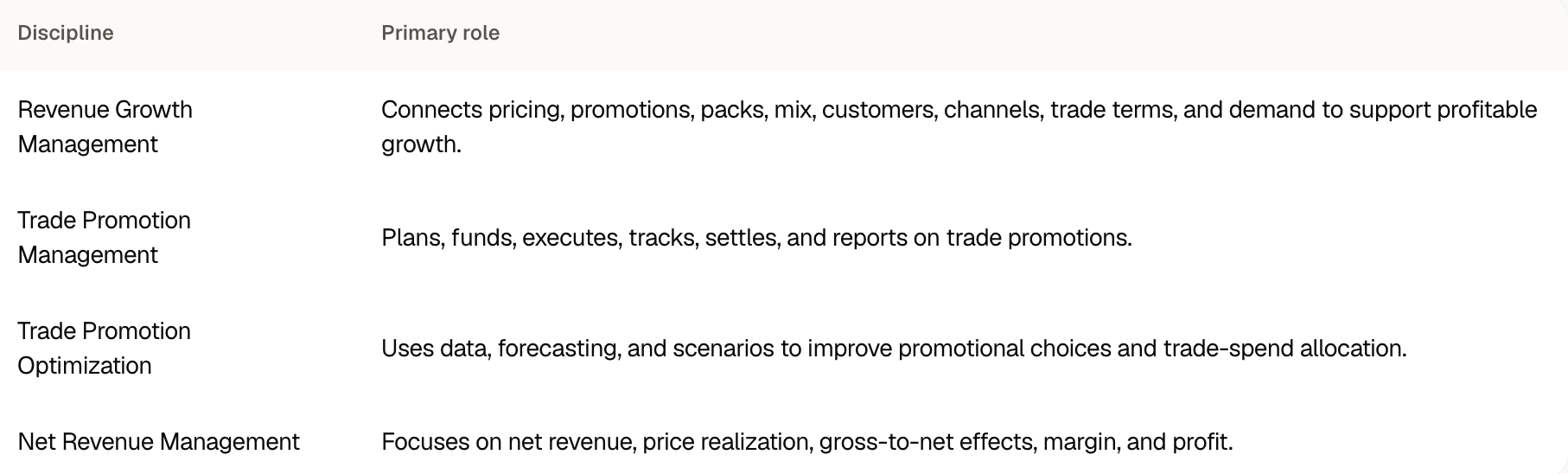
These boundaries are not universal. Some companies use Net Revenue Management as another name for RGM. Others treat NRM as the profitability lens within a broader RGM program.
The practical takeaway is that brands should define the terminology they use internally. The label matters less than whether the team is connecting commercial decisions to net revenue and profit.
Trade Promotion Management is the operational process for planning, funding, approving, executing, settling, and evaluating promotional activity with retailers or other trade partners.
A TPM process may include:
TPM provides an important execution and visibility foundation. However, a TPM system can record and execute a promotion without determining whether that promotion was the best use of the brand’s resources.
Trade Promotion Optimization is the analytical and predictive layer that helps teams evaluate promotional choices.
TPO may help compare:
A practical distinction is simple:
TPM helps manage the promotion lifecycle. TPO helps evaluate promotional choices. RGM connects those choices to the broader commercial strategy.
Net Revenue Management focuses on what remains after discounts, trade terms, fees, rebates, and other commercial investments are considered.
It is closely related to RGM, but the relationship varies by organization. Some companies use NRM as the preferred name for the full discipline. Others use NRM to describe the net-revenue and profitability component of RGM.
Trade promotion ROI is one of the most important inputs into RGM, but it is not the same thing as RGM.
RGM uses promotion performance to help determine:
To evaluate a promotion, a brand needs an estimate of what sales would have been without the promotion. That is the baseline.
A simple planning concept is:
Incremental sales = actual promotional-period sales minus estimated baseline sales.
The baseline is not automatically last year’s sales or the average of the previous few weeks. It may need to account for seasonality, trend, distribution, regular price, competitor activity, product availability, retailer or channel differences, other promotions, and product lifecycle.
A promotion can create sales lift without creating profit.
A stronger evaluation considers:
The exact ROI formula varies by organization. A common profit-oriented formulation is:
Trade promotion ROI = incremental profit attributable to the promotion divided by total trade investment.
Companies may instead use incremental revenue, gross profit, contribution margin, or another measure in the numerator. Two ROI figures are not comparable unless the definitions are consistent.
A promotion can appear successful at the event level while weakening the broader portfolio.
Potential issues include:
This is where RGM extends beyond simple promotion reporting. It asks whether the investment improved the broader business and whether the result should change the next plan.
RGM and demand forecasting are closely connected because commercial decisions change demand assumptions.
A promotion can affect expected volume, timing, customer demand, product mix, inventory requirements, production, shipping, service levels, and retailer commitments.
Demand forecasting estimates what is likely to happen under specific assumptions. Demand planning turns that estimate, along with commercial commitments and operational constraints, into an agreed plan.
A useful distinction is:
A forecast is an estimate. A demand plan is an agreed decision about what the organization will plan around.
A typical workflow may look like this:
The connection is important because a demand forecast that ignores commercial plans can be misleading. At the same time, a commercial plan that ignores supply, inventory, and operational constraints may not be executable.
When the forecast changes, teams need to understand why.
Was the change caused by a new promotion, a deeper discount, a price increase, a distribution expansion, a product launch, a seasonality shift, a retailer commitment, a supply constraint, or a change in product mix?
RGM helps make those commercial drivers visible. That gives sales, finance, marketing, demand planning, and supply chain a more consistent basis for discussing the plan.
RGM does not replace demand planning. It makes the commercial assumptions behind the demand plan easier to understand, challenge, and improve.
A practical RGM process does not need to begin with a massive transformation. It does need a repeatable way to connect data, decisions, execution, and learning.
A useful starting point is:
The process is most valuable when it becomes recurring rather than a one-time analysis.
Vividly helps CPG brands connect trade data, promotion analytics, forecasting, and RGM expertise to make better decisions about growth, investment, and profitability.
Vividly’s public materials describe capabilities across trade promotion planning and management, promotion analytics, trade-spend analysis, trade promotion optimization, forecasting, deductions management, post-event analysis, forward planning, price-pack architecture, and price elasticity.
Vividly’s RGM offering extends its trade-data and optimization foundation with consulting modules that include data readiness, post-event analysis, forward planning, and price-pack architecture and elasticity work. The exact scope depends on the selected offering, data foundation, and engagement requirements.
The point is not to automate every commercial decision. It is to give CPG teams better-connected information, scenarios, and recommendations so they can make more informed decisions.
If your brand is managing trade investment across disconnected spreadsheets, struggling to explain forecast changes, or growing revenue without enough visibility into profitability, an RGM conversation can help clarify where to start.
To see how these commercial decisions can be connected in practice, explore Vividly’s Revenue Growth Management approach.
RGM stands for Revenue Growth Management. It is a commercial discipline for connecting decisions across pricing, promotions, packs, product mix, customers, channels, and demand to support more profitable growth.
A CPG brand may need RGM when trade investment is becoming harder to explain, promotions are being repeated by habit, pricing and trade decisions are disconnected, forecast changes are difficult to attribute, or portfolio and customer complexity is increasing. There is no universal revenue threshold.
TPM manages the operational lifecycle of trade promotions. RGM takes a broader view and evaluates how trade decisions connect to pricing, mix, packs, customers, channels, demand, and profitability.
TPM helps plan, execute, track, and settle trade promotions. TPO uses analytics, forecasting, and scenarios to improve promotional choices.
A brand typically starts by estimating baseline sales, measuring incremental sales or profit, and comparing the result with total trade investment. The exact formula depends on how the company defines incremental value, margin, and trade spend.
Demand forecasting estimates likely demand under specific commercial assumptions. RGM helps define and evaluate those assumptions, including the expected effects of price, promotions, mix, and distribution.
The terminology varies. Some organizations use Net Revenue Management as another name for RGM, while others use NRM to describe the net-revenue and profitability component of a broader RGM program.
Revenue Growth Management helps CPG brands move from managing disconnected commercial activities to making more connected growth decisions.
It brings together the questions that determine whether growth is valuable:
TPM helps manage the promotion lifecycle. TPO helps improve promotional choices. Demand forecasting helps estimate likely demand. NRM helps evaluate net revenue and profitability. RGM connects those decisions into a broader commercial system.
For brands that want to grow more profitably, the first step is not necessarily choosing a new tool. It is understanding where disconnected decisions are creating risk and where better data, scenarios, and processes could create more value.
That is the conversation Vividly’s RGM offering is designed to support.


Discover a new vision for trade
.webp)
.webp)

.webp)
.webp)

.webp)
