
Prefer to listen instead? Check out the audio version of this article
When not managed closely, brands lose roughly 1% of revenue to invalid deductions every year, deductions they should have disputed and been paid back for. With trade spend running around 20% of revenue, recovering just 5% of that trade budget is real money: for a $50MM brand with $10MM in trade, that’s $500K back to the bottom line.
AI can help, but in today's industry, it doesn’t. AI makes it easier than ever to deliver incomplete features to customers and declare success. They solve part of the problem a user faces - but part of the problem might as well be none of the problem because the user then needs to work out where it breaks and how to put a new workflow in place.
The TPM industry - and software more broadly - is littered with vendors promoting features that, when they hit reality, don’t actually solve a problem.
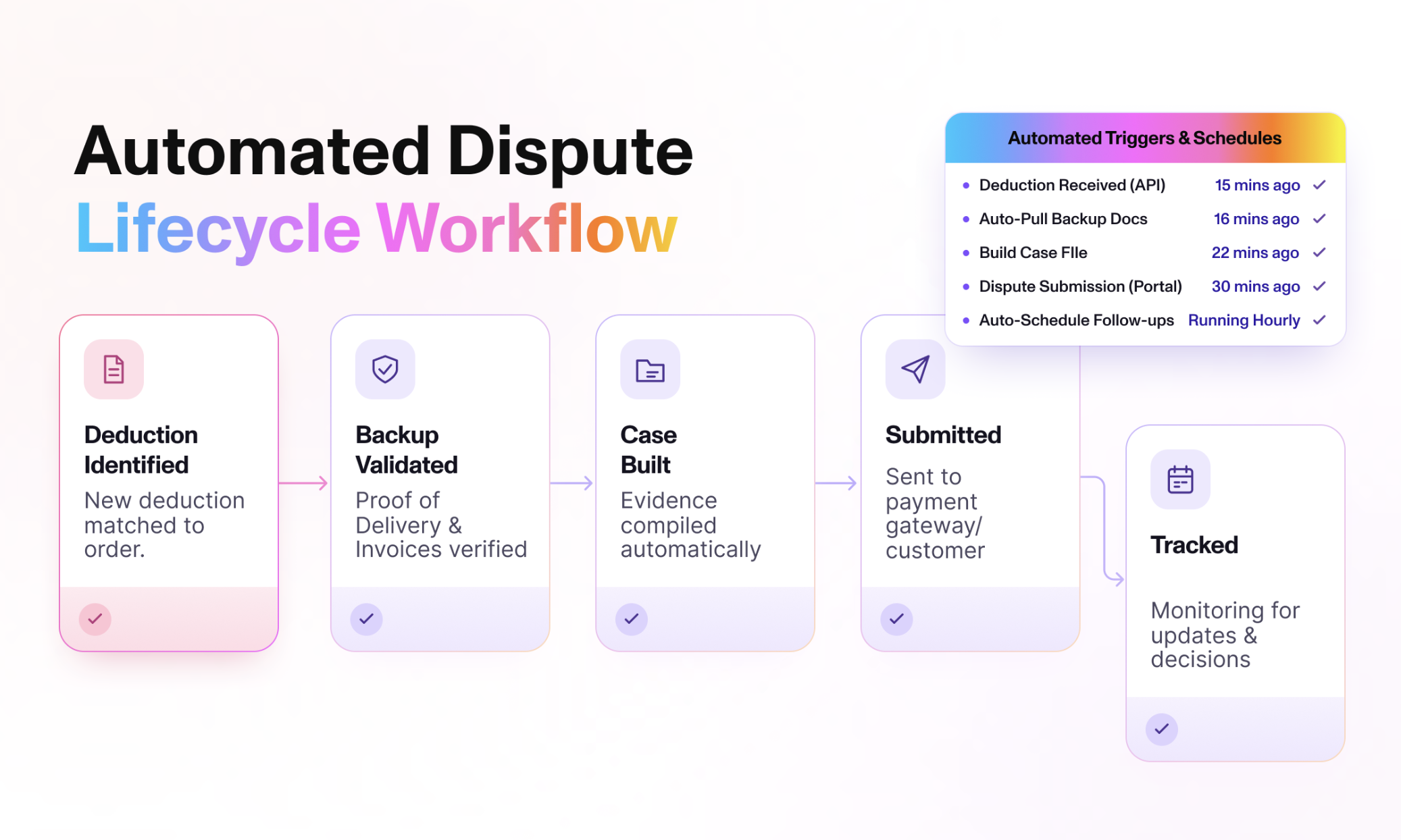
Last week, we announced a new capability, one that we have been patiently refining so it actually works in real life: Automated Disputing, powered by AI. Disputing invalid deductions is hard. It takes deep knowledge of the dispute workflows, which vary by retailer, distributor, and dispute type. And any misstep means the dispute gets rejected, which potentially means lost cash and certainly means rework.
This complexity makes it very challenging for AI for a number of reasons.
1. Context
AI needs deep context. Providing it requires knowing all the variability described above, knowledge that comes only from experience working through hundreds of thousands of disputes across all national and regional distributors and retailers. That experience is hard to come by.
As a simple example: every distributor and retailer has its own dispute rules, from required documentation to submission channels to formatting. Miss one and your dispute can be rejected without notice, never even receiving a ticket number to track it. Without deep context, AI misses these critical details.
2. Exception management
AI needs training on the vast array of exceptions. Even with great context on the workflows a dispute should follow, there are always exceptions. Recall-related spoilage deductions are one example: they’re less common and require specialized experience. The only way to teach AI how to handle them is volume. It needs exposure to a massive number of disputes across a wide range of workflows to be effective, and that kind of exposure is very hard to find. You won’t find it at any single brand. You can only find it by looking across hundreds of brands and hundreds of thousands of disputes.
3. When to loop in a human
AI needs to know when to ask a human for help, like with the recall-related spoilage exception above. This is fundamental to any AI workflow. If the AI isn’t trained on points 1 and 2, it can’t know when it’s out of its depth. It will keep working, make mistakes, and subsequently cause dispute rejections and more work for the humans depending on it.
We hear feedback from brands who have tried Auto (or AI) Disputing from other TPM vendors, and it’s been consistent: it sounds great, but it doesn’t meet the real-world need. It solves only a very narrow, simplistic workflow, precisely because of i) a lack of context and understanding and ii) a limited scope of supported retailers and dispute types.
That makes it effectively useless and, worse, creates more work for the brand to tidy things up. The failure modes map to the 3 points above: a shallow understanding of the dispute process, exceptions left stranded and unmanaged, and execution with either too much or too little human oversight.
With Vividly’s new Auto Disputes, we have addressed each of the challenges that make Auto Disputes hard. We are unique in the industry in that, while we have a rich and robust trade planning and deduction management platform that is designed for brands to own and operate themselves, we also have a comprehensive Deduction Management Service team that will manage the end-to-end deduction and dispute resolution process on behalf of our brands.
In the case of Auto Disputes, only by having both the managed service and the technology platform can you create the reinforcing cycle that addresses the 3 points above that cause AI to fail in the disputing process.
1. Vividly Difference: Context
Our managed service team has created over 500 policies that define the dispute process across all national and regional retailers and distributors, including the dispute types for each. This includes email- and portal-based disputes. This is unique context that you can only obtain by working across hundreds of brands over multiple years.

2. Vividly Difference: Exception management
Since we have seen significant volume, we have seen the exceptions. We have processed billions of dollars in deductions for our customers, generating $60M+ of disputes across 50,000+ individual cases. Again, that volume is higher than that of all but the largest brands in the world and offers more variety than even they do.
3. Vividly Difference: When to loop in a human
We’ve handled a high volume of deductions for our brands over the past five years, so we know where the checkpoints belong. We know when something needs a more senior team member to review because we have learned what happens when you skip that step. So we have built this into our agentic architecture - it’s because we deeply understand the AI’s limits that we’re able to deploy it more effectively.

Finally, we are not simply releasing an AI capability and hoping that it works when it meets reality. We have been using this capability with our own Deduction Management Service for months - training, refining, measuring and improving to the point where we trust it.
And the repayment rates we’re achieving - 95% repayment rate on shipment-related deductions and a 75% repayment rate on trade-related deductions - tell us we have got it right.
The work doesn’t stop with this launch. Our team will continue using this feature, refining it and passing those improvements directly to all our customers who use our Auto Disputes.



Discover a new vision for trade
.webp)
.webp)

.webp)
.webp)

.webp)
